Your Worldwide Resource to Figure Skating Online.

FOLLOW US

Follow Us on RSSJoin us on Facebook! Follow us on Twitter!


Share |

2009 Four Continents Figure Skating Championships

Compulsory Dance; Pairs and Ladies Short Programs

February 5, 2009
Article by Elvin Walker
Photos by Jay Adeff

 
2009 Four Continents

February 4-8, 2009
Vancouver (BC), Canada

DAY 2
DAY 3
DAY 4
FULL RESULTS

STANDINGS

ICE DANCE (FINAL):

1. Davis/White USA
2. Virtue/Moir CAN
3. Samuelson/Bates USA

PAIRS (FINAL):

1. Pang/Tong CHN
2. Dubé/Davison CAN
3. Zhang/Zhang CHN

LADIES (FINAL):

1. Kim Y. KOR
2. Rochette CAN
3. Asada JPN

MEN (FINAL):

1. Chan CAN
2. Lysacek USA
3. Kozuka JPN


The 2009 Four Continents Figure Skating Championships are being held Feb. 4-7 in Vancouver (BC), Canada at the Pacific Coliseum. It is the third time since 1999 that Canada has hosted this event. Approximately 108 skaters/teams from 16 different countries are competing for points and global prize monies totaling $250,000 in U.S. dollars.

In addition, the top three skaters and couples per discipline having earned the most World Standing points during the 2008-09 season, will be awarded with a World Standings Bonus.

The competition kicked off on Feb. 4 with the Compulsory Dance.

Ice Dance (Compulsory Dance)

"Time" was the common theme among the top competitors in the compulsory dance at the Four Continents Championships. As each team completed their dance, they expressed the wish to have more time to prepare the Finnstep - the new compulsory dance, which was just added this season. The competitors also discussed how much fun the Finnstep has been for them, and expressed regret that it might never be competed again.

"I don't think anybody who has competed this dance has felt that they gave the performance what it deserved," said USA's Kimberly Navarro. "We would have liked to have had more time to learn it, perfect it, and really show what it is all about."

The Finnstep, inspired by former European Champions Susanna Rahkamo and Petri Kokko from Finland, may have seen its first and last hurrahs. The compulsory dance as a competitive entity is up for review by the International Skating Union, and it is possible that it could be eliminated from competition following the 2010 season.

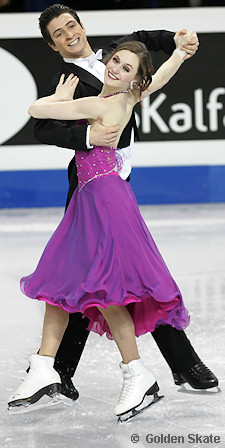
Tessa Virtue and Scott Moir - Four Continents Figure Skating Championships - Compulsory Dance Canada's Tessa Virtue (19) and Scott Moir (22) perform the Finnstep in the Compulsory Dance.

Navarro said what almost every other skater felt today, "It really is a fun dance to do. It's a shame that we may never see it competed again."

Meanwhile on the ice, Canadians Tessa Virtue (19) and Scott Moir (22) earned the highest score of the afternoon in their international debut this season.

"This dance is definitely more fun than some of the other compulsories that have been around a while," Moir said. "It's just a matter of not having the time to properly prepare. We did the best that we could with the time that we had to get ready."

Virtue has been recovering from an October surgery to treat a condition called chronic exertional compartment syndrome, which caused the Worlds silver medalist considerable pain in both legs.

"Nationals was a stressful week," Virtue confessed. "Not just physically, but emotionally draining as well. But I am feeling better every day. It's good to be on this side of recovery now."

Nevertheless, the reigning Canadian champions performed with their usual technical accuracy, placing them ahead of their training mates, Americans Meryl Davis and Charlie White. Virtue and Moir earned a respectable 36.40 points with Davis (22) and White (21) nipping at their heels with 35.23 points.

The newly-crowned American Champions skated a peppy and entertaining Finnstep, but were unable to outscore their friendly rivals.

"It's always great to get the first one out of the way," White said with his trademark smile. "It's always fun to get out there under the lights with the crowd cheering you on. It's always a great thing to skate well."

The effervescent duo expressed the character of the dance, but perhaps weren't as big in their patterns as the leaders.

"We were ready before Nationals to be on this track," Davis said. "We knew that our schedule was going to be tight, so we were prepared for a long season."

"It's worth it though," added Davis. "This is where the Olympics are going to be held, and we wanted to take advantage of the opportunity to compete here."

Finishing in third place was the Canadian silver medalists, Vanessa Crone (18) and Paul Poirier (17), who are making their senior international championships debut on home ice.

"It was a really good dance for us," admitted Crone. "We really didn't know what to expect with the marks obviously since this is a new dance, but we are happy with what we did."

Crone and Poirier earned 32.43 points with a performance that suggests that this team is a real threat for the podium in this competition.

"It's fun to have the expectation on us, and to have the home crowd behind us," said Poirier. "It's great to think that we were once the kids cheering on the athletes, and here we are competing and having the kids cheer for us. There is a little bit of added pressure, but it is up to us to accept that and become better competitors."

In fourth place, the American team of Emily Samuelson (18) and Evan Bates (19) spoke of how they perhaps made history in this competition.

"I think that we might be the last team to ever compete the Finnstep," said a nostalgic Bates. "We're pretty excited about that!"

The reigning U.S. silver medalists looked impressive throughout their program, showcasing their long lines and spunky personalities, and earned 31.41 points in this phase of the competition.

"I like the dance," Samuelson admitted. "It's something fun and different. We thought that it was going to be horrible to learn, but it's actually not that bad, and we enjoyed doing it today."

Canadians Kaitlyn Weaver and Andrew Poje and Americans Kimberly Navarro round out the all North American top six.

Pairs (Short Program)
Qing Pang and Jian Tong - Four Continents Figure Skating Championships - Pairs Short Program Qing Pang (29) and Jian Tong (29) of China placed first in the Short Program with their routine to Midnight Blues by Gary Moore.

Qing Pang (29) and Jian Tong (29) of China took the lead after the pairs short program, skating a sleek program to the music of Irish blues guitarist Gary Moore. The reigning Four Continents Champions are looking to retain the Chinese stronghold on the Four Continents title and attempting to win China's eighth title in the event's eleven-year history.

The Chinese champions opened with an uncharacteristic mistake as Pang doubled an intended triple toe loop to begin the program. The duo quickly recovered and skated clean from that point on, showcasing their trademark triple Lutz twist lift.

Both Pang (thigh) and Tong (Achilles tendon) have been plagued by injuries this season, but neither seem affected by the setbacks.

"We're old," joked Tong. "The injuries caused us some difficulties tonight, however, we are getting therapy and we're getting better."

"It wasn't the program that we wanted," added Pang. "but we hope things go better for us tomorrow."

With a short program total of 65.60 points, Pang and Tong edged out Canada's Jessica Dubé and Bryce Davison, who had a relatively clean skate early in the competition.

Skating to an orchestral version of Coldplay's Fix You, the reigning Worlds bronze medalists opened with clean triple Salchows, but then made a small timing error on the landing of their triple Lutz twist lift. Dubé (21) and Davison (23) also received a one-point deduction for going over the time allowed for a short program.

"At the end of the program, we were a little bit late coming out of our pairs spin," Davison explained. "We didn't realize that we were late until we got off the ice, and (our coach) told us that we went over."

The two-time and current Canadian Champions actually scored higher than the leaders on the technical elements marks, but had to settle for second due to lesser program component scores. Their short program total of 64.36 points is well off of their personal best, but it was their strongest outing this season.

"It's our best short program of the year, and we are looking forward to carrying that momentum into the long," Davison said.

Finishing in third place was Dan Zhang (23) and Hao Zhang (24) of China. After a strong opening of a beautiful triple Lutz twist lift and an easy throw triple loop, Dan Zhang singled an attempted triple Salchow.

"The jump was no problem in practice," Dan Zhang noted, "but the rest of the program was without mistake."

The two-time and current World silver medalists skated competently after the mistake, but seemed lethargic and calculated, which resulted in a sterile performance of their Riding on the Wings of a Storm program.

"I don't feel like our speed was a problem," admitted Hao Zhang. "The (music) itself is a little slow, but everybody skates differently, so to us, this was the correct speed."

The Olympic silver medalists earned 63.20 points in the short program, and are close enough to the leaders to pull off a win.

In fourth place was the Canadian team of Meagan Duhamel (23) and Craig Buntin (28), who skated an inspired program to 4 Lamentations.

"It was a great performance for us," said an energized Buntin. "It was a special moment for us, and we skated well. All of our levels were where we wanted them to be, so we are happy with what we did today."

The Canadian silver medalists won over the crowd, and perhaps had the loudest ovation of the afternoon. However, Duhamel and Buntin only received a level one for their pairs combination spin, and also opted to do a double flip twist lift instead of the higher scoring triple that the top three completed.

"It's a tough call (to attempt a triple twist)," Buntin said. "The overall impression is better with a triple twist, but if you look at score sheets, our level four twist is comparable with most of the level one and two triple twists in the world. For now, we are debating it, we're working on a triple, and we'll see how it goes."

Duhamel and Buntin earned a new personal best of 62.08 points, and are in good position to steal one of the podium spots if any of the top three struggle in the free skate.

Americans Rena Inoue and John Baldwin finished in fifth place with 56.78 points after making mistakes on both the throw triple loop and triple Lutz twist lift.

Canadian bronze medalists Mylène Brodeur and John Mattatall finished in sixth with a new personal best of 55.16 points, while U.S. Champions Keauna McLaughlin and Rockne Brubaker struggled to a disappointing seventh (54.16).

Ladies (Short Program)
Yu-Na Kim - Four Continents Figure Skating Championships - Ladies Short Program South Korea's Yu-Na Kim, 18, placed first in the Short Program with her routine to Danse Macabre by Camille Saint-Saëns.

It was supposed to be a battle of the two super powers of ladies figure skating. World Champion Mao Asada of Japan taking on two-time Worlds bronze medalist Yu-Na Kim of South Korea.

Asada and Kim have arguably created figure skating's most interesting rivalry in this Olympic cycle. The last time the two met was at the Grand Prix Final in December in Kim's home country, with Asada coming out on top. In Vancouver, however, Asada had perhaps skating's worst meltdown of the season, while Kim had a record-breaking evening.

Kim skated a beautifully mischievous and perfectly off-center program to Danse Macabre that electrified the crowd, breaking her own world record in the process.

"When I was preparing for the Four Continents, I tried my best to stay healthy," said the oft-injured Kim. "Last season I was having injuries in February, so I couldn't prepare so well. So this season I'm in my best condition, and to have achieved my best score makes me very happy."

The Canadian-trained Kim was solid from her opening triple-flip triple toe loop combination all the way to the end. Had it not been for a level three step sequence, Kim could have been as close to perfect as a skater has ever been since the new judging system was implemented.

"I am very happy to be here where the Olympics will be next year," Kim said with enthusiasm. "And of course, I am happy that I got a new personal best score."

Kim was so precise that she earned positive grades of execution (GOE) on each of her executed elements, garnering the leader 7.30 points more than her start value. In addition, the 18-year-old was rewarded with the highest program component scores of the night - a well-deserved victory for one of the most inspiring performances in the history of skating.

"It took me a long time to clean up this program," explained Kim, "and I am so happy that I did it today. I still can improve my steps and spins."

Kim's total score of 72.24 points eclipsed her previous best by .29 points - a record that had stood for almost two years.

Asada, on the other hand, struggled from her opening triple flip-triple loop, getting called for an under rotation on the back half of the combination. The reigning World Champion pulled herself out of contention altogether when she doubled her next element - a planned triple Lutz.

"My jumps have not been great since practice this morning," admitted the 18-year-old. "That just carried over to the program unfortunately."

The Japanese champion did land a clean double Axel, but looked nervous throughout her routine to Clair de Lune as she finished the short program in sixth place.

"I'm not satisfied with this performance," said a sedate Asada. "I want to forget today's bad performance. I want to set my mind positively for the free skate, and want to give my best."

Asada was also not rewarded with high levels on her spins, earning just a level two on her flying sit and layback spins. With a disappointing score of 57.86 points, the defending champion will have to hope for a miracle to pull up into gold medal contention.

In second place is the five-time and reigning Canadian champion Joannie Rochette, who overshadowed the World Champion with a confident skate.

"I'm really happy with how things went tonight," said Rochette. "I think that this is my harder program, so after nationals, we made some changes. We changed the elements order and some of the elements, but with only one week to really work on it, this is what I could do. Leading up to Worlds, we will continue to work out the program, but I am very happy with the result so far."

Rochette opened her Summertime routine with a beautiful double Axel, and then opted for a triple Lutz-double toe loop combination which was originally planned to be a triple-triple.

"After I landed the first triple, the landing wasn't good enough to add a triple onto the end," explained the 23-year-old. "My goal was to do a clean program, and I wanted to see all of the changes that we had made in one week."

The reigning Four Continents silver medalist performed with a sophisticated coolness, which helped her to earn a new personal best of 66.90 points.

"I'm just glad with the overall performance, with so little time," said Rochette. "And achieving my current best without the triple-triple is very good for me. Of course I still want to challenge myself and land it in competition before I finish my career for sure."

Making perhaps the comeback of the season thus far is Rochette's teammate, Cynthia Phaneuf, the 2004 Canadian champion. Phaneuf was thought to be Canada's rising star after she won the national title, but injuries kept her sidelined for almost two seasons. Returning to competitive skating in the fall of 2006, Phaneuf has struggled to regain her form until tonight.

"I am really excited to finally put out a clean short program," said the composed Phaneuf. "It has been since 2005 for me."

The two-time and current Canadian silver medalist skated a clean and technically pleasing program to Aaron Rosand's Nocturne, complete with a triple Lutz-double toe loop combination. She is in third place after the short program, and increased her personal best by over three points to 60.98 points.

"Nothing was really different tonight than at nationals," Phaneuf said. "I think that my confidence was just higher. This is the breakthrough that I have been looking for."

Another surprise in the competition is the fourth place finish of Japan's Fumie Suguri. After winning a silver medal at the 2006 World Championships, Suguri struggled to place high enough to get out of her national championships. This season has been somewhat of a rebirth for the 28-year-old as she medaled at both of her Grand Prix events, and earned a ticket back to the World Championships with a silver medal winning performance at the Japanese National Championships in December.

"After Torino, I wanted to stay competitive on the same level, but I had a difficult time in perfecting my technique," Suguri admitted. "I was really tired after the Olympics, but I really love my sport. I created my own goals for when I compete, and I just love figure skating so much."

Suguri continued, "In the six minute warm-up, they announced me as 'Fumie Suguri, 28 years old', and I was like, 'No! Don't say that!' But I still feel like I can bring more to my skating, so that is why I am still doing it."

Suguri skated like the elder stateswoman of the competition, taking time to commit to each element in her Fanfan program, and using a mature presentation style to complement her technical successes in the program. The two-time olympian landed a triple (f)lutz-double toe loop combination to start, and went clean the rest of the way through the program.

"Of course I am very happy with not only my placement, but I am also pleased with my skate," Suguri said confidently.

Suguri scored 60.18 points on the night, keeping her hopes alive for a medal in this championship.

Finishing in fifth place was USA's Caroline Zhang with an up and down program that disappointed the 2007 World Junior Champion.

"It was really shaky," said the World Team alternate. "It wasn't my best performance. I really didn't have much expression."

Zhang opened with a gutsy try at a triple flip-triple toe loop combination that fell short of rotation on the back half.

"It's the only bad one that I had done all week," lamented the 15-year-old, "and I had to do it in the competition."

The current U.S. bronze medalist scored a total of 58.16 points for her routine to La Bayadere, just edging out the World Champion Asada.

USA's Alissa Czisny made two big jump errors and had to settle for seventh place, while teammate Rachael Flatt finished just behind her in eighth. Japan's Akiko Suzuki and Canada's Amelie LaCoste are ninth and 10th respectively.

The event continues with the Original Dance, the Pairs Long Program, and the Men's Short Program.

Valid XHTML 1.0 Transitional